BEHAVIOUR OF BETTA SPLENDENS

Siamese fighting fish, (Betta splendens), freshwater tropical fish of the family Osphronemidae(order Perciformes), noted for the pugnacity of the males toward one another. The Siamese fighting fish, a native of Thailand, was domesticated there for use in contests.
Combat consists mainly of fin nipping and is accompanied by a display of extended gill covers, spread fins, and intensified coloring. The fish, elongated and slender, grows to a length of about 6.5 centimeter’s (2.5 inches). In the wild it is predominantly greenish or brown with moderately sized red fins; under domestication it has been bred with long flowing fins and in a variety of colors, such as red, green, blue, and lavender.
Betta fish are among the most popular and beautiful pet fish in the world,
but that wasn’t always so. The genus Betta contains more than 73 recognized species, but the fish most people are familiar with is Betta splendens, or Siamese Fighting Fish.
Wild betta fish are a dull greyish-green with short fins; nothing like the spectacularly colored, long-finned beauties of
today! Through selective breeding, a wide range of colors and fin types have been developed, including: veil, delta, halfmoon, crown tail, double tail and many more.
THE HISTORY OF SIAMESE FIGHTING FISH
Betta splendens are native to Thailand, Cambodia, Laos and Vietnam, where they live in ditches, rice paddies, shallow pools and slow-moving streams. To survive in these warm, oxygen-poor habitats, they use a special labyrinth organ which allows them to breathe air above the water surface, although they also have gills like other fish. Because of this ability, some people believe
bettas can be kept in small bowls or flower vases. As pets, bettas should be kept in a filtered, heated aquarium with ample room for decorations and for the betta to swim around in, and at a temperature between 76° and 84° F. At lower temperatures, they become sluggish and
susceptible to disease. Plants and other decorations to provide cover and a secure lid is also required, especially in small containers, to prevent your betta from jumping out of its fish tank in search of a cleaner, or larger body of water. Bettas are carnivores, feeding primarily on insects
and insect larvae in the wild. They thrive on protein-based frozen, pellet and flake foods in aquariums.
The betta got its name from an ancient clan of warriors, called the “Bettah”. The fish were given a combatant name after the fighting fish became popular in the mid-1800s. In fact, the sport became so renowed in Thailand that the former King of Siam had it regulated and taxed.
Spectators of the sport based their bets on the bravery of the fish, rather than the damage inflicted by the victor.
Breeding the males as ornamental fish for local sale and exporting is also becoming increasingly lucrative. The features favored by aficionados and amateurs alike are color intensity, color pattern, scale iridescence, body shape, and fin size. Changing the emphasis of breeding from fighting to ornamental bettas is preferable not only for ethical reasons but also for commercial reasons in that the export market for the latter is larger and has higher profit margins. According to the Department of Fisheries (2000– 2005), bettas ranked among the top two ornamentals in terms of number of fish and revenue.
PIGMENTS AND BODY COLOURS
Pigments of bettas give rise to red, blue, green, and yellow body surface colors and also to scale iridescence. Pigments are compounds of the general structures such as melanin’s, carotenoids, xanthine’s and pterins whereas iridescent compounds on the scales and body surfaces are
guanines and purines. These pigments are also common in other animals.
However, fish have special pigment cells (chromatophores) which respond to neural signals for quick outward expression by deepening of color intensity and changing of shades. Developmental biology and molecular biology techniques should help to produce desired body color patterns on demand.
The chromatophores of fish change colors in accordance with the habitat, the environment and stimuli. There are two types of chromatophore, those that absorb lights in the visible range (melanophores, erythrophores, xanthophores and cyanophores) and those that reflect light (leucophores and iridophores). The pigments are moved intracellularly by motor proteins such as tubulin, dynein, and kinesin.
The pigment cells respond to brightness, ultraviolet light, pressure,
temperature, fish activity, pH, and chemicals via the neurohumoral and neurochemical systems producing melanophore-stimulating hormone, adrenocorticotrophic hormone, prolactin, somatolactin, melanin-concentrating hormone, melatonin, epinephrine and norepinephrine. Wild Betta splendens are colorful and sexually dimorphic (i.e., males and females look different
from one another), with males being more brightly colored than females. Because of their attractive colors and interesting behaviors, this species has been subject to many years of artificial selection (particularly the males) for mutant color morphs and very long fins and tails.
Despite the domestic variety's showier appearance, its courtship and other intraspecific displays have remained relatively unchanged. Both wild and domestic Betta splendens will react strongly and aggressively to the appearance of another fish of the same species.
Agonistic (from the Greek agonistes, meaning "champion") behavior in animals is defined as that exhibited during a contest, combat, escape, attack, or appeasement episode between two animals.
The term is often used to describe the display behaviors exhibited by male animals when they compete for mating opportunities with females.
Male Bettas may fight to claim territory, or to protect their eggs or offspring from rival males. But physical combat is invariably preceded by a display sometimes called "flaring." When stimulated by the sight of a rival male (the releaser), a male Betta will exhibit several types of genetically determined aggressive movements (fixed action patterns).
The fish will spread his fins, shudder his body, extend his gill opercula and membranes, and generally appear much larger than his resting size. Bettas do not recognize themselves in a mirror, and will display to their reflections as aggressively as they might to another male. Male and Female Bettas use all their fins in their displays, as well as their opercula and the fleshy, colorful extensions beneath the opercula. Male fighting fish vary in their aggressive response and you will attain the best results will be from the more aggressive males.
The sight of its own reflection in a mirror is enough to stimulate agonistic flaring in a sufficiently aggressive male (they do not recognize themselves, and think they see another male). To assess the relative aggressiveness of the animals at your station, and to observe the behaviors associated with agonistic display, slowly and carefully place a small mirror against the flat side of the bowl.
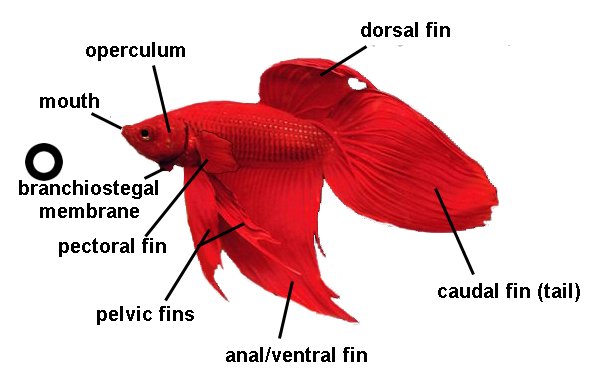
1. Dorsal Fin – Used primarily to stabilize the betta in the water and to aid in turning.Consists of many branches. One of three unpaired fins
2. Caudal Fin – Often called the tail fin, the caudal fin is used for propulsion and is often the first fin to deteriorate when bettas experience fin rot. In rare cases, bettas may bite their own caudal fins causing fin loss. Bettas have been selectively bred to illustrate a variety of caudal fin shapes including halfmoon, double tail, delta tail and the common veil tail. One of three unpaired fins.
3. Anal Fin – Used for stabilization while swimming. One of three unpaired fins
4. Pectoral Fins – Used for turning and propulsion. These paired fins are located just behind operculum.
5. Ventral Fins – Sometimes called pelvic fins, these are used for fine motor skills like sharp turning, ascending and descending in the water column and stopping. These are paired fins.
6. Operculum – The gill covers that protects the fragile gill tissue from injury or damage.
7. Caudal Peduncle – The area at the posterior end of the betta’s body just before the caudal fin begins.
8. Eye – Bettas have very good eyesight and can see in color. They often react to movement outside their tank or their own reflection.
9. Mouth – Bettas have an upturned mouth used positioned to fetch insect larvae and small insects from the water’s surface.
AGGRESSIVE BEHAVIOUR
Another factor that may pose problems for big scale breeding and propagation is the excessive aggressive behavior of bettas raised in a litter, especially for the ornamentals, because they need an appearance untouched by biting. Bettas are social animals capable of living in groups with a pecking order or in isolation.
They are very territorial, especially after isolation or during courtship. Their aggressiveness is usually expressed by body color intensity, expansion of fins, and opening of gill covers (opercula), which are all features preferred by the females. Although such expressions give rise to the splendours of the fish and the obsession of gamblers on results of their fighting, people who raise them as
ornamentals would prefer to have such beautiful displays with minimal fighting.
Hence breeding out the aggressiveness or genetically modifying the fighting tendency would make keeping home-based bettas in large groups a better prospect, instead of only in isolation as generally practiced. Success in this direction would enhance their position as truly ornamental. In trying to tone down the male aggressivity, one has to keep in mind that the male courtship display should still be effective.


No comments:
Post a Comment